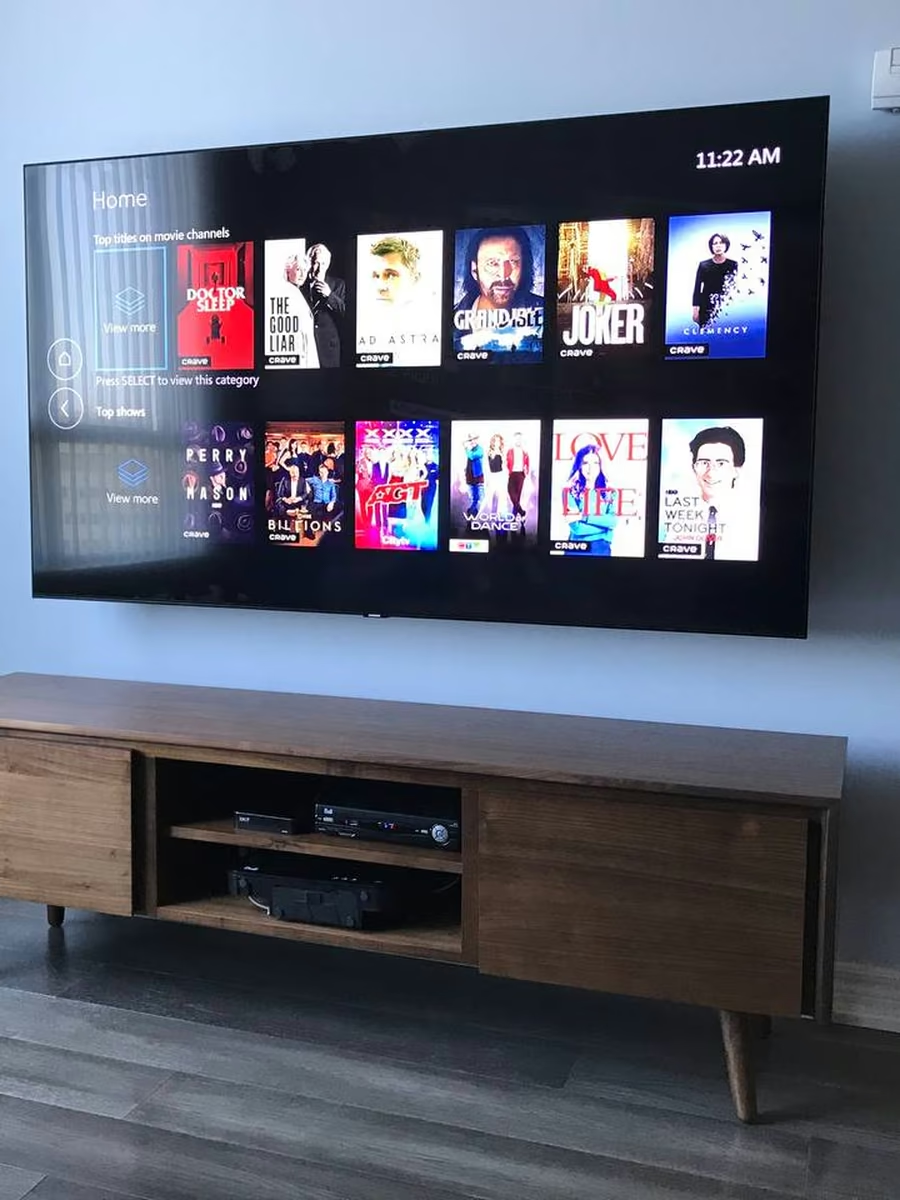
Precision TV Wall Mounting in Toronto, Measured Before It’s Drilled

We find the structure behind your wall and prove it’s there before a single hole goes in. Then the bracket gets anchored to suit what the wall’s actually made of, shimmed flat, and levelled to your room rather than to a stud that isn’t plumb. From $179.99.

More than 10,000 installs behind us, a one-year material and workmanship warranty, and $2,000,000 in liability insurance.

Recognised by

HomeStars Best of Award winner 2018–2023 · Best of Houzz Service 2018–2021

TV Wall Mounting Across Toronto and the GTA

Straight pricing, a one-year workmanship warranty and $2,000,000 in liability cover on every job.

Call (647) 839-5215

The part that happens before the drill

Anyone Can Hang a TV. Getting It Right Is the Part That Takes Time.

A TV comes off the wall for one of three reasons: it was fixed to drywall instead of to structure, the anchor was wrong for what the wall’s made of, or the bracket was tightened onto a surface it was never sitting flat against. All three are decided in the twenty minutes before anything is drilled. That’s where our time goes.

  • Structure First, Then a Position

    We locate what’s behind the wall and confirm it before marking anything. If the spot you want has nothing solid behind it, you’ll hear that while it’s still a conversation rather than after there are four holes in your wall. We won’t hang a television off drywall anchors alone and call it finished.

  • The Wall Picks the Anchor

    Wood studs, metal studs, poured concrete, brick, plaster and lath, tile over backer. Each one wants a different fastener, a different drill and a different technique, and the hardware in the mount’s box only ever covers the first of them. We bring the right anchor for what’s actually there.

  • Level to the Room, Not Just the Bracket

    A bubble on the bracket tells you the bracket’s level. It tells you nothing about whether the TV will look level once it’s hanging under a ceiling line and over a mantel that are both slightly out. We check it against the room before the screen goes on, because that’s the version you’ll see every evening.

Installer sweeping a wall with an electronic stud detector to confirm stud positions before marking a TV bracket
Finding the stud is quick. Proving it’s a stud and not a pipe, a duct or a run of conduit is the part worth paying for.

Step one, every single time

Finding the Structure, and Proving It’s Actually There

A stud finder is a starting point, not an answer. It’ll happily beep over a water pipe, a bundle of cable or the edge of a duct. So we cross-check every reading before it becomes a hole.

Three ways to confirm one stud

We sweep the area with the detector, then check the edges to find the centre rather than guessing at it. A magnet picks up the drywall screws running up the stud, which gives a second, independent line. And where the wall’s already been worked on, the switch and outlet boxes are usually nailed to a stud edge, which gives a third.

Studs sit at 16 or 24 inches on centre in most GTA homes, so once we’ve got one confirmed we know roughly where its neighbours are. That’s a prediction to verify, not a licence to start drilling.

What we’re checking isn’t there

Wiring, plumbing and HVAC all live in the same cavity. Below an outlet, above a baseboard heater, or anywhere on the wall shared with a bathroom or a kitchen, we slow down and treat the space as occupied until we’ve shown it isn’t.

A pilot hole is cheap. A nicked supply line inside a finished wall is not.

When the spot you want has nothing behind it

It happens more than you’d think, usually because the wall was picked for the furniture rather than for the framing. Two options. A bracket with a plate long enough to span two studs lets us shift the fixing without shifting the screen, and our basic tilting mount reaches three. Or we move the TV a few inches and you never notice.

What we don’t do is fill the gap with anchors and hope.

Fastener choice, by substrate

The Hardware in the Box Only Fits One Kind of Wall

Mount manufacturers ship the fasteners for drywall over wood studs, because that’s the common case. Everything else is on the installer. Here’s what we reach for, and why.

What we fix into, and what we fix with. Screen weight sets the size of the fastener in every row; the wall sets the type.
What the wall isWhat holds the bracketWhy
Drywall over wood studsLag bolts driven into the stud through pilot holesThe bolt has to bite solid timber, not the drywall in front of it. Pilot-drilling first stops the stud splitting and stops the bolt wandering off the centre line.
Light-gauge metal studsToggle-style anchors set through the stud webA metal stud is a hollow section. A lag bolt has nothing to grip, so the load goes onto a toggle rated to the screen weight instead.
Poured concreteSleeve or wedge anchors, hammer-drilled to depthThe strongest fixing available and the least forgiving. Hole depth and diameter have to match the anchor, and there’s no adjusting the position afterwards. See mounting a TV on a concrete wall.
BrickAnchors set into the brick body, not the mortar jointMortar is softer and crumbles under load. We drill the brick itself, which holds.
Plaster and lathLong fasteners through the plaster into the stud behindLath will flex and plaster will crack if you load it. The fixing has to reach past both into real timber. See mounting a TV on a plaster wall.
Tile, stone, marbleMasonry bits, slow speed, no hammer mode, anchors sized to the screenThese crack if you rush them, and there’s no undoing a hole in a marble slab. Quote-on-photo jobs, every time.
Technician setting a tilting TV bracket to a cross-line laser with a box level across the rail before tightening the bolts
The bubble is one input. The cross-line laser, the ceiling line and the mantel are the others.

Two different measurements

Level to the Wall and Level to the Room Aren’t the Same Thing

Put a spirit level on a bracket and you’ll get one answer: is this bracket level. That’s the easy question, and it’s the only one most installs bother asking.

Why the room wins the argument

Your ceiling line, your mantel, the top of your window frame and the run of your crown moulding are all things the eye reads as horizontal, and in a real house at least one of them isn’t. Hang a perfectly level TV under a ceiling line that drops half an inch across the wall and the TV is what looks crooked, because the ceiling is the longer reference.

So we level the bracket properly, then check it against whatever the room will compare it to. If the two disagree we raise it rather than picking one silently. Nine times in ten the bubble wins.

Why a bracket gets shimmed

Walls aren’t flat. Drywall bulges over a proud stud, a taped joint sits a millimetre or two out, plaster undulates by more than that. Bolt a rigid steel plate across an uneven surface and it either twists as it tightens or sits on the high point and rocks.

Shims go behind the plate at the low spots so the whole thing bears evenly before anything gets tightened down. It’s the difference you’d notice from the sofa without being able to name it.

The last adjustment happens with the TV on

Most decent brackets have a few degrees of side-to-side play built in, which is there so the final tweak can happen once the screen is hanging and the weight is on. We use it.

Levelling an empty bracket and then walking away is how a TV ends up a degree off with nobody able to fix it.

One visit, start to finish

What Install Day Actually Looks Like

We work 9:00am to 8:00pm seven days a week and can usually be with you the same day or the next. These are our own installs, photographed as they happened.

How long does it take to mount a TV on the wall?

About 45 minutes for a standard mount on drywall, and it’s always one visit. Wire concealment, masonry walls and fireplace mounts add time on top. We work 9:00am to 8:00pm, seven days a week, and can usually be with you the same day or the next.

  1. Installer putting on shoe covers at the door before starting a TV mounting job 1

    Shoe covers, then furniture back

    Covers go on at the door, the furniture moves clear of the wall and a drop sheet goes down. It takes two minutes and it’s the difference between a tidy job and drywall dust worked into your carpet.

  2. Installer locating and confirming wall studs with a detector before marking bracket positions 2

    The wall gets read

    Structure located and confirmed three ways, and the cavity checked for wiring and plumbing before anything is marked. This is the step that decides whether the rest of the job is straightforward.

  3. Installer measuring and marking the mounting height on a wall with a tape measure and pencil 3

    Height agreed from your seat

    We sit where you sit and mark the height that puts the middle of the screen at or just below your eye line. You look at the mark before we drill. Height is the thing you live with every evening.

  4. Installer drilling a TV bracket fixing while holding a vacuum nozzle at the bit to catch the dust 4

    Drilled with the vacuum at the bit

    Pilot holes first, anchors chosen for the substrate, and a vacuum held at the bit as it goes in. The dust ends up in the vacuum rather than down your baseboards.

  5. Installer checking a mounted TV bracket with a spirit level before fitting the screen 5

    Shimmed, then levelled twice

    The plate is shimmed until it bears flat, levelled against itself, then checked against the room. On an uneven wall this is where the time goes, and it’s the step that decides how the finished job reads.

  6. Two installers lifting a large flat-screen TV onto a wall bracket together 6

    Lifted, tested, tidied

    Big screens go up as a two-person lift, not balanced on somebody’s knee. Then your devices go back on, every input gets switched through, and the packaging leaves with us.

Installer fitting the bracket arms to the back of a television with the correct length of bolt
Two numbers on the back of the TV decide which brackets are candidates. We check both before the wall is touched.

Height, VESA and weight

The Two Measurements That Decide Whether You Like It

One of them is about the room and one is about the television. Get either wrong and no amount of care on the rest of the job makes up for it.

Height comes off your seat, not off the wall

The single most common thing we get called back to correct is a TV mounted too high. It happens because whoever fitted it was standing up at the time, and standing at a wall with a drill is the one viewing position nobody ever watches TV from.

Our method is boring and it works: we sit where you sit, mark the height that puts the middle of the screen at or just below your eye line, and you look at it before we drill. Where a mantel forces the height up, a tilting bracket buys back some of the angle. That’s a compensation, not a fix, and we’ll say which one you’re getting.

We check your TV before we check your wall

Two numbers on the back of every television decide which brackets are even candidates. The VESA pattern is the spacing of the four threaded holes, in millimetres. The weight is the weight. A bracket has to accept both, and plenty of the ones sold in a box with a picture of a big TV on it accept neither.

If you’ve already bought a bracket, we’ll fit it once it checks out, and we’ll tell you plainly if it doesn’t rather than fitting it anyway and hoping.

Bolt length and how tight is tight enough

The VESA holes on a TV are threaded inserts in a thin panel, and they strip. A bolt that’s too long bottoms out against the panel behind them; one that’s too short takes the load on two or three threads. Both fail quietly, months later.

So the arms get the right length of bolt with spacers where a curved or recessed back needs them, threaded in by hand first to prove they’re started square, then brought up firm and stopped. Firm, not maximum.

Wall-mounted TV with every cable concealed inside the wall and nothing visible below the screen
Where the cable goes changes where the bracket goes. It’s decided before the plate is bolted on, not after.

Decided before the bracket, not after

Where the Cables Go Is Part of the Mounting Plan

Cable routing gets treated as tidying up at the end of a job. It isn’t. Where the wires go changes where the bracket goes, and working that out after the plate is bolted on is how a wall ends up being opened twice.

Can you hide the wires when you mount my TV?

Yes, in the same visit, and in-wall concealment starts at $99.99 on regular drywall. Where the wall’s construction allows it, the signal cables run inside the cavity. A concrete condo wall gets a slim painted channel instead, and the TV’s power cord never goes in the wall without an in-wall-rated solution.

Three routes, and the wall decides which are available. Inside the cavity, which is the cleanest and needs the construction to allow it. Into a slim painted channel on the surface, which is what a concrete condo wall leaves you. Or straight down behind the furniture, which costs nothing and is honestly fine in a bedroom.

There’s one rule that isn’t negotiable: standard TV power cord doesn’t go inside a wall. Signal cable can be run in the cavity, but mains power needs an in-wall-rated solution, and that’s a different piece of work with a different price. The full detail is on our invisible wire concealment page, and it starts at $99.99 on regular drywall.

If there’s anything else that ought to be in that wall — an Ethernet drop, a spare HDMI, speaker runs — the moment to pull it is while the wall is open. Doing it now is structured low-voltage cabling and it’s cheap. Doing it next year means opening the same wall again and it isn’t.

TV wall mounting Toronto & GTA

Check out our recent installation projects

116 photos

Three brackets, three jobs

The Mounts We Carry, and What Each One Is Rated For

You can supply your own and we’ll fit it once we’ve checked it against your screen. If you’d rather we brought one, these are the three we keep on the van. Every figure below is the manufacturer’s rating, and every one of them is checked against your TV’s actual weight before it goes up.

Which TV wall mount should I choose?

A basic tilting mount if you watch the screen straight on, and a full-motion mount if you need to turn it toward different seats. The tilting one carries up to 75kg with 10° of tilt. The single-arm full-motion holds up to 60kg, and the double-arm takes screens up to 90 inches and 65kg.

Single arm full motion TV wall mount with the arm extended from the wall plate

Single-Arm Full-Motion Mount

  • Most 37″ to 70″ flat or curved panels
  • Supports up to 60kg / 132lbs
  • 24″ extension arm, 180° swivel
  • High-gauge steel that won’t bend, sag or wobble

Pull the screen off the wall and turn it toward the kitchen, the corner chair, or wherever you actually end up sitting. It holds the same weight as the double-arm system and gives you more room to swing side to side.

Get an estimate
Double arm full motion TV wall mount holding a large flat screen angled away from the wall

Double-Arm Full-Motion Mount

  • Most 37″ to 90″ flat or curved panels
  • Supports up to 65kg / 143lbs
  • 24″ extension arm, 180° swivel
  • High-gauge steel that won’t bend, sag or wobble

Same idea as the single arm, more capacity. The second arm is what buys the extra reach and the extra stability once you’re into the larger screen sizes.

Get an estimate
Basic tilting TV wall mount fitted flat to a wall with its long mounting plate visible

Basic Tilting Mount

  • Most 37″ to 70″ flat or curved panels
  • Supports up to 75kg / 165lbs
  • 10° tilt range for glare control
  • Plate long enough to reach three studs

The flattest and least expensive of the three, for a wall you view straight on. It carries the most weight of any mount we stock, because a fixed plate bears load better than an articulated arm, and that plate length makes for a very secure installation.

Get an estimate

Supplied and installed

Somewhere for Everything That Plugs Into It

A mounted TV usually comes with a console, a soundbar and a box or two that still need somewhere to live. We supply the shelf and fix it into the same structure the bracket went into, in the same visit. The prices below are the shelf and the installation together. Already own the shelf? We’ll hang yours from $60.

Single floating shelf installed on the wall below a mounted TV

Single shelf

One level under the screen. Enough for a console, a streaming box and the thing the internet comes out of.

$199 Installed

Two floating shelves installed on the wall below a mounted TV

Double shelf

Two levels, which is where most setups land once a games console and a soundbar are in the picture.

$229 Installed

Three floating shelves installed in a stack on the wall beside a mounted TV

Triple shelf

Three levels for the setups that have genuinely run out of room. Same fixings, same load check, one more shelf.

$299 Installed

Not sure what’s behind your wall?

Send a photo of the wall and the TV and we’ll tell you what it needs, and what the job will actually cost, before we arrive.

Request a Quote

TV Wall Mounting Prices

A fixed or tilt mount on regular drywall starts at $179.99 and a full-motion mount starts at $189.99. Here’s that alongside everything else we get asked about most.

The job Price
Fixed or tilt mount TV up to 65", regular drywall from $179.99
Full-motion mount TV up to 65", regular drywall from $189.99
Wire concealment Regular drywall from $99.99
TVs above 75" Call for an exact quote from $200
Frame TV or LG G-series Up to 65", regular drywall from $259.99
Frame TV or LG G-series 77" and up from $299.99
Metal mount installation above a fireplace from $399.99
Above fireplace, under cabinets, marble or stone walls Call to confirm

Prices exclude hardware and are estimates only. We confirm your final price by phone or email once we’ve seen photos and the details of your setup.

Every number is labour, not the bracket. What moves it is the size of the screen, what the wall is made of, and where the TV has to sit. Marble, stone, under-cabinet and above-fireplace jobs need different anchors and take longer, so we quote those on a photo. The full TV mounting cost breakdown goes through what moves each number, with example totals.

Send a photo of the TV, the wall and where you want it, and we’ll quote the whole job before we arrive.

By the numbers

TV Wall Mounting, Backed by the Numbers

10K+ Installations completed

20+ Years combined experience

5.0 Average rating across 1,340+ reviews on Google, Yelp and HomeStars

$2M Liability cover

Every installation is backed by a one-year material and workmanship warranty, and we carry $2,000,000 commercial liability insurance — a certificate is available on request. See the work or the project write-ups.

Areas We Serve

TV Wall Mounting Across Toronto and the GTA

Same method in a downtown condo with concrete walls as in a detached house out in the regions — the anchors change, the checking doesn’t. Pick your city below for local pricing and wall-type detail.

  • Primary Service Hub Greater Toronto Area & surrounding regions
  • Certified Coverage $2M liability insurance and a full one-year material and workmanship warranty
Check Availability Near You

Questions we get asked

How We Mount It, Answered

The method questions people ask before booking. If yours isn’t here, just ask us — we answer these all day.

How do you find the studs before drilling?

Three ways, cross-checked against each other. An electronic detector sweep to find the edges and work out the centre, a magnet to pick up the drywall screws running up the stud, and the switch and outlet boxes, which are usually nailed to a stud edge. Studs sit at 16 or 24 inches on centre in most GTA homes, so once one is confirmed we know roughly where the next one should be. That is a prediction we verify, not a licence to start drilling.

Do you check for wiring or plumbing behind the wall?

Yes, before every hole. Wiring, plumbing and ductwork share the same cavity as the studs, and a detector will happily beep over a pipe. Below an outlet, above a baseboard heater, or on any wall shared with a kitchen or bathroom we slow down and treat the space as occupied until we have shown it is not. A pilot hole is cheap. A nicked supply line inside a finished wall is not.

What is the difference between level to the wall and level to the room?

Level to the wall is what a spirit level on the bracket tells you. Level to the room is whether the TV looks straight next to your ceiling line, your mantel and the top of your window frame, and in a real house at least one of those is out. The eye trusts the longer reference, so a perfectly level TV under a ceiling that drops half an inch is what looks crooked. We check both, and if they disagree we talk to you about it rather than picking one silently.

Why would a TV bracket need shimming?

Because walls are not flat. Drywall bulges over a proud stud, a taped joint sits a millimetre or two out, plaster undulates by more. Bolt a rigid steel plate across that and it either twists as it tightens or rocks on the high point. Shims go behind the plate at the low spots so the whole thing bears evenly before anything is tightened down. It is the difference between a screen that sits flat and one that stands slightly proud at one corner.

Which anchors do you use on concrete, brick or plaster?

Concrete gets sleeve or wedge anchors hammer-drilled to depth, which is the strongest fixing there is and the least forgiving about hole size. Brick gets anchors set into the brick body rather than the mortar joint, because mortar crumbles under load. Plaster and lath gets long fasteners driven through both into the stud behind, since lath flexes and plaster cracks. Metal studs get toggle-style anchors through the web. The hardware in a mount's box only ever covers drywall over wood studs.

How do you check my TV will fit the mount?

Two numbers decide it: the VESA pattern, which is the spacing of the four threaded holes on the back in millimetres, and the weight of the screen. The bracket has to accept both. We confirm them before anything is drilled, and if you have already bought a mount that is not rated for your TV we will tell you plainly instead of fitting it anyway and hoping.

Can the bolts into the back of a TV be overtightened?

Easily, and it is a common way to ruin a television quietly. Those VESA holes are threaded inserts in a thin panel and they strip. A bolt that is too long bottoms out behind them, a bolt that is too short takes the load on two or three threads. We use the right length with spacers where a curved or recessed back needs them, start every bolt by hand to prove it is square, then bring it up firm and stop. Firm, not maximum.

What gets tested before you leave?

Your devices go back on, every input gets switched through, and we confirm picture and sound with you watching rather than reporting that it works. On a full-motion mount we run the tilt and swivel through their full travel to check nothing is fouling and the cable slack is right at both extremes. Then the packaging leaves with us and the floor gets cleaned. That is part of the job, not a line on the invoice.

Does all this checking cost more?

No. A fixed or tilt mount on regular drywall starts at $179.99 and a full-motion mount at $189.99, and the checking is what that buys. It is the installation itself, not an upgrade on top of it. Every job carries a one-year material and workmanship warranty, and we carry $2,000,000 commercial liability insurance with a certificate available on request.

Free Quote

Ready to get it on the wall properly?

Send the TV model, the screen size, a photo of the wall and your postal code, and we'll come back with a firm price — no site visit needed for most jobs.

Takes about a minute · One-year workmanship warranty · $2,000,000 liability insurance