
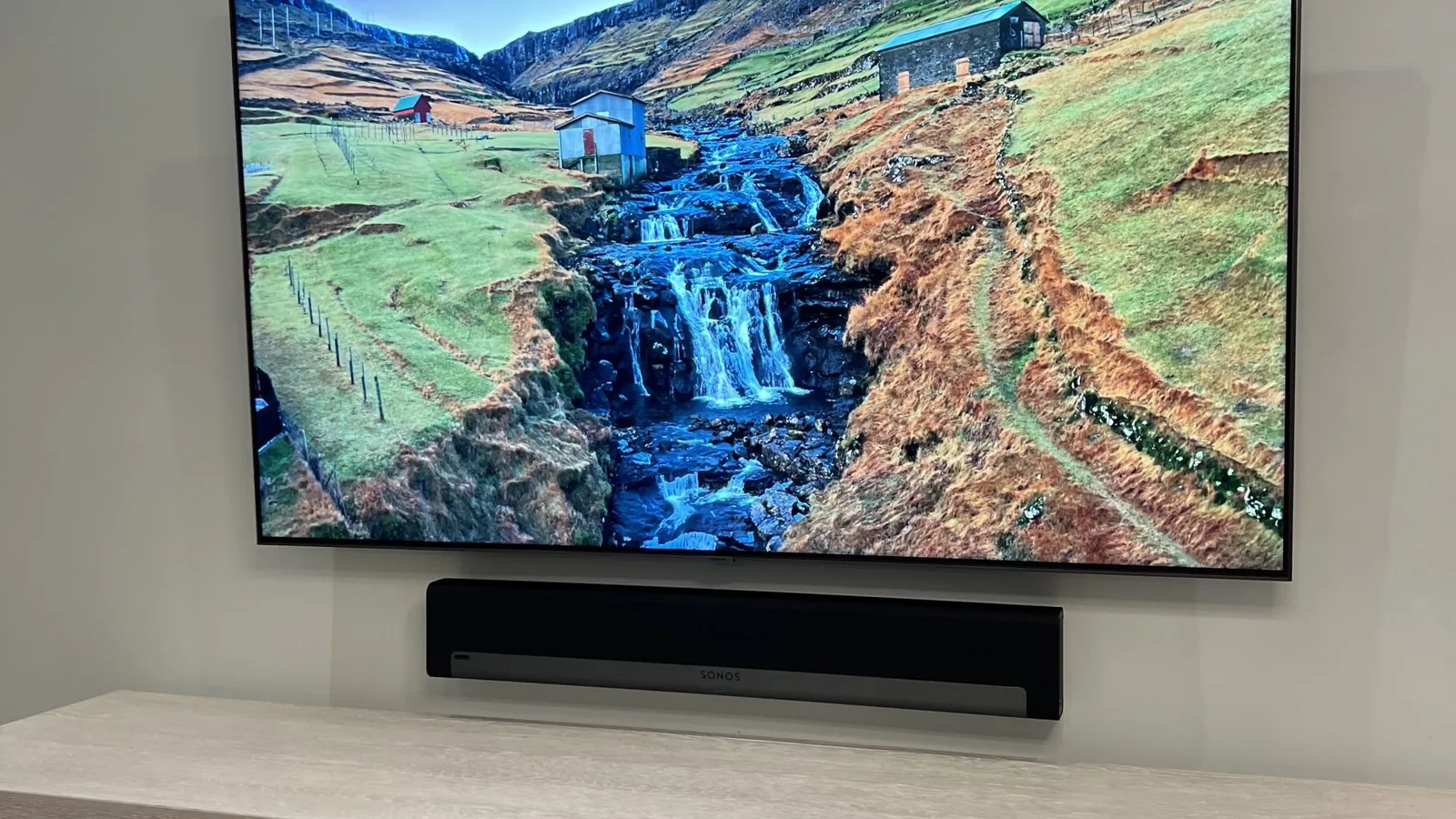
Soundbar Installation and Mounting in Toronto
A soundbar sounds better and looks better once it’s properly mounted: level with the screen, at a sensible height, with the cables out of sight. Our soundbar installation service covers Toronto and the GTA, on drywall, plaster, brick and concrete, either on the bar’s own bracket or attached to the TV itself. Book it with a TV install or add it to a screen that’s already on the wall.
- 1 yearMaterial & workmanship warranty
- $2 millionLiability insurance
- 7days a week, 9am to 8pm
Recognised by
HomeStars Best of Award winner 2018–2023 · Best of Houzz Service 2018–2021
Recent job
TV, Soundbar and Cabinet on One Wall
A Hisense ULED on the wall, a Bose soundbar right under it, and a floating cabinet below that. We hung all three.
When one crew does every piece, the centre line is everybody’s job, not nobody’s. The bar sits square under the screen, the cabinet sits square under the bar, and nobody’s lining up against something another installer put up last month. Count the cables between them. You won’t need long.
Planning a floating cabinet too? Mention it when you book and we’ll set the bar height around it.
Soundbar Mounting Across Toronto and the GTA
Straight pricing, a one-year workmanship warranty and $2,000,000 in liability cover on every job.

The service
What a Soundbar Install Involves
Depending on the room and the gear, an install can cover mounting the bar, lining it up with the TV, concealing the cables, connecting everything, and confirming sound actually comes out before we pack up. Not every job needs all of that, and we won’t pretend yours does.
A bar already sitting on a credenza that just needs to go on the wall is a short visit. A bar under a fireplace-mounted TV, on a full-motion arm, with the HDMI run inside the wall, is a different job. We’ll work out which one you have from your models and a photo, and tell you what’s involved before anyone turns up with a drill.
The other thing that decides the visit is the building. A detached house in the 905 and a twentieth-floor suite downtown are the same job on paper and different jobs in practice: different walls, different anchors, and in the condo’s case a certificate of insurance and a booked elevator before anyone drills anything.
Plenty of people reach us with the television already on the wall and only the bar left to sort out. That is a normal booking, not an awkward one, and nothing has to come down for it. If the TV is still in its box, it is worth booking the TV and soundbar together instead, and most soundbar work rides along with a TV installation that way.
Options
Where the Soundbar Can Go
The best position depends on your bar, your TV, the wall behind them, and where you actually sit.

Wall mounted directly below the TV
The common answer, and usually the best-sounding one. Nearly every bar is voiced to fire forward from just under the screen, so dialogue arrives from the picture rather than from a cabinet off to one side. If you bought a soundbar mainly because you were tired of missing half the words, this is the position that fixes it.
We set the gap on purpose. Tight enough that the bar and the panel read as one object, wide enough to clear the bottom bezel and the television’s infrared sensor, and high enough above a credenza that the drawer underneath still opens. On a 65-inch screen that usually lands around two inches. Where a media unit sits close beneath, the bar rises and the TV rises with it.
A soundbar wants to fire at seated ear level, and seated ear level in a living room sits lower than most people hang a television. So we set the screen off where you actually sit and hang the bar under it, instead of centring the TV on the wall and finding out afterwards that the bar is aimed at your forehead.
Width matters as much as height, and it’s the part people forget. A bar noticeably narrower than the screen reads as an accessory bolted underneath; one wider than the screen reads as a mistake. Where the two are close we centre the bar on the panel, because your eye lines them up against each other and never against the room.
Your building decides the fixings, not your preference: studs where there are studs, rated anchors where there aren’t, sleeve anchors into concrete. There’s more on that further down the page.
What your bar comes with, and what it doesn’t
Four groups, and yours is in one of them. Some bars ship with a bracket in the box. Some have keyhole slots moulded into the back and need nothing else. Some take a model-specific kit sold separately. And some have no mounting points at all.
That last group is the one worth catching before somebody is standing in your living room holding a drill, and it’s why we ask for a model number instead of a brand. Send it over and we’ll tell you which group yours is in and what it needs. There’s a brand-by-brand breakdown further down the page.
- Gap under the screen
- Clears the bezel and the IR sensorWider where a cabinet sits close underneath and the drawer still has to open.
- Height
- Seated ear levelWhich is lower than most people hang a television.
- Fixings
- Confirmed before we drillWhat is behind the surface decides the anchor, and we check before we drill.
- What we need from you
- Two model numbers and a photoThe TV, the soundbar, and the wall shot from far enough back to show the whole area.

Attached to the TV or the TV mount
Bolt the bar to the television instead of to the wall and the two travel together. One set of holes, permanent alignment, and nothing to redo the day you swap the screen for a bigger one. In a downtown condo, where every hole is a hammer drill into structural concrete, halving the count is reason enough on its own.
Three mechanisms do it. A sandwich plate that traps the bar’s bracket between the TV and its VESA holes. A clamp that grips the arm of a full-motion mount. Or a model-specific kit built for one bar and one bracket. Which one you need depends entirely on what you own, and the mount has to be rated for the added weight and leave clearance behind the panel for both sets of hardware.
Sonos’s own brackets for the Arc and the Beam fix to the wall, not to a screen, so hanging either off the TV means a third-party kit instead of the factory one. Several Samsung bars pair to a matching Samsung mount and sit almost flush. We check the bar, the mount and the panel together before quoting, because two out of three means we can’t hang it.
The other thing attaching buys you is cable slack. A bar fixed to the wall under a moving TV drags its own HDMI lead every time the arm swings. A bar riding on the arm keeps the same loop through the whole range, which is one fewer thing working itself loose over a couple of years.

On a shelf or on furniture
Sometimes a bracket is the wrong answer. Some bars have no mounting points and were only ever meant to sit on a surface. Some walls talk you out of it: a thin partition, decorative stone you would rather not core, a rental where the lease settles the argument. A floating shelf or the top of a media unit is a perfectly good home for a soundbar.
The shelf has to be rated for the weight with the bar sitting on the front half of it, and deep enough that nothing overhangs the edge. Hollow units buzz at volume, so a bar with any real bass wants something solid under it. And the shelf goes at a height that keeps the bar firing at you, not at the coffee table.
This is the route a Sonos Beam or a Ray takes in plenty of rentals, and where a Samsung bar lands when the wall behind the television is glass, tile or someone else’s property. We still handle the alignment, the connection and the cable tidy-up, and the wireless subwoofer still needs somewhere sensible to live, which usually means the same wall as the bar, not behind the sofa.
If drilling is off the table entirely, say so when you book. It changes what we bring and it changes the quote, and it is much easier to know in advance than to find out at the door.
Wall mounted above the TV
Mounting above the TV works in two situations: the screen sits low, or a media unit fills the space underneath. Even then, two things push back. A bar up there is firing over your head instead of at you, and most aren’t designed for it. And any bar with upward-firing Atmos drivers needs open ceiling to bounce off, which is exactly what you take away by mounting it close to one. A Sonos Arc, or one of the bigger Q-series bars that carry up-firing drivers, shoved under a bulkhead throws away the height channel you paid for. If your model is a poor candidate we’ll say so instead of mounting it anyway.
With a full-motion TV mount
Full-motion arms force a choice, and both answers are valid. Attach the bar to the TV or the arm and it swings, tilts and extends with the screen, staying lined up wherever you point it — though the arm carries more weight and the cables need more slack. Fix it to the wall instead and the TV moves while the bar stays put, which looks right in the home position and slightly off everywhere else.

Wiring
Getting the Cables Out of Sight
The signal side can usually disappear into the wall. The power side is more of a decision. Which approach we use comes down to what your wall is made of, and it’s the same work covered on our invisible wire concealment page.
A bar under a wall-mounted TV has two runs to deal with, and they aren’t the same problem. The signal side is one HDMI eARC lead, or an optical cable on older gear. It’s low-voltage, so an in-wall-rated CL2 or CL3 cable can legally run inside a hollow wall, between two brush plates. That rating matters: the lead that came in your soundbar box usually doesn’t carry it. The power side is a standard cord that isn’t rated to sit in a wall at all, and no amount of wanting it hidden changes that.
Half of it disappears. The other half is a decision. Hiding the power means a code-compliant in-wall kit or a recessed outlet behind the bar, which is electrical work with a cost attached. Leaving it visible means a short drop into whatever sits underneath, and on a bar tucked close under the screen that’s often barely noticeable. We show you both before we cut anything.
One condo note. Anything touching the power side is electrical work, and plenty of buildings want it declared before it happens. If your job needs a recessed outlet rather than a signal-only run, we flag it early so it does not stall your booking with property management.
-
Surface raceway
A slim paintable channel down the wall. The go-to on concrete and masonry, and on any wall you’d rather not open up.
-
In-wall low-voltage routing
In-wall-rated HDMI, optical and speaker cable run inside a hollow wall between brush plates, so nothing shows between the TV and the bar. Needs a clear cavity and a CL2 or CL3 lead. Same discipline as our low-voltage cabling work.
-
Power
Standard power cords aren’t rated for the inside of a wall, so we don’t put them there. The options are in the wiring section above.
-
Existing conduit or pre-wiring
Newer builds often already have a conduit or pre-run behind the TV. If yours does, we’ll use it and cut nothing new.
-
Behind the furniture
Where the bar sits on a shelf or unit, cables get bundled and clipped out of the sightline. Often all a room needs.
Where you live decides the hardware
What Your Wall Is Probably Made Of
The approach shifts with the building far more than with the postal code. Across Toronto and our GTA service areas, almost every soundbar lands on one of these three walls — and each one takes different anchors, a different cable plan and, sometimes, different paperwork.
-
Condo and high-rise — poured concrete
Downtown Toronto, the Mississauga city centre towers, the Yonge corridor through Richmond Hill and Vaughan. Structurally it’s the most secure fixing available, and practically it means a hammer drill, sleeve anchors and no cavity to hide a cable in — so the signal run goes into a slim painted channel instead.
-
Older Toronto homes — plaster and lath
The pre-war stock through the old city, East York and the inner suburbs. Plaster crumbles differently than drywall and a stud scanner reads it badly, so we confirm the framing by hand before committing to a hole. Worth knowing before someone puts a drywall anchor into a hundred-year-old wall.
-
Newer 905 builds — drywall over wood stud
Most of what we see in Markham, Vaughan, Brampton, Whitby and Oakville. The friendliest wall of the three: real studs to hit, a clear cavity for an in-wall signal run, and often a conduit already behind the TV from the builder. Steel studs turn up in some newer townhouse blocks and change the fixings.
Compatibility
What Decides Whether It’ll Work
Soundbars aren’t standardised the way TV mounts are. There’s no universal bracket, so these are the things we check first.
-
Your soundbar’s mounting points
An included bracket, moulded keyhole slots, a model-specific kit sold separately, or none at all — it varies by model, and two bars from the same maker often differ. Sonos, Samsung, Bose, LG, JBL and Yamaha all mount fine; it’s the model number we need, not the badge.
-
Your TV and its mount
Panel size and VESA pattern decide what can bolt to the TV. Fixed, tilting and full-motion mounts each leave different clearance and carry a different load.
-
Width and weight
A bar wider than the TV throws the wall off visually. A heavy one changes which anchors suit, and whether hanging it off the mount is sensible.
-
What’s behind the wall
Wood studs, steel studs, plaster and lath, concrete and block all take different fixings — and which one you have usually follows the age and type of the building, as above. We confirm what’s back there before drilling, not after.
-
Your building’s rules
Most GTA condo boards want a contractor’s certificate of insurance on file before work is approved, and many want the service elevator booked and the job done inside set hours. We carry $2,000,000 in commercial liability cover and send the certificate to property management on request — tell us the building early and it won’t hold up the date.
-
Fireplaces
Above a firebox the wall is often stone, brick or tile and mantel clearance is tight — which usually pushes the bar onto the TV or mount. See TVs mounted above a fireplace for how those jobs run.
-
Media and connect boxes
A separate box — a Samsung One Connect, a receiver, a streaming device — still needs somewhere to live and a cable path back to the TV.
-
Atmos and up-firing drivers
Bars with upward-firing speakers need open ceiling above them. Sloped ceilings, bulkheads and high positions all interfere.
-
Remote and sensor clearance
Positioned badly, the bar blocks the TV’s IR sensor or its own. We check line of sight from where you actually sit.
By brand
Sonos, Samsung and the Rest of What We Mount
Model still beats brand, as the section above says. But here’s what we see most and what each one tends to do: where the bracket fixes, whether one came in the box, and how much the bar cares about what sits above it. Six groups cover almost everything we mount across the GTA.
-
Sonos Arc and Arc Ultra
Sonos makes a wall bracket for the Arc and a separate one for the Arc Ultra, and they aren’t interchangeable, so the model number matters here more than usual. Either bracket holds the bar at the angle Sonos voices it for. Both bars fire upward for Atmos height, which means they want open ceiling above them. Under the screen in a room with a flat ceiling is where an Arc does what you paid for. Under a bulkhead, or up above the TV, is where the height channel goes missing.
-
Sonos Beam and Ray
Easier neighbours. Neither has up-firing drivers, so neither is fussy about what sits above it, and Sonos makes a wall bracket for the Beam. Both are short enough to look right under a 55-inch screen without the bar reading as an afterthought, and both are common on a floating shelf in a condo where drilling the feature wall is not an option.
-
Samsung Q-series
Among the easier bars to hang, because Samsung generally puts a bracket and a paper drilling template in the box. The bigger Q-series bars carry up-firing drivers, so the ceiling rule above applies to them too. Pairing one with a Frame TV is its own small problem: the point of a Frame is that it sits flush, so we place the bar where it does not undo that.
-
LG, Bose and Sennheiser
All three mount, and all three vary more within their own ranges than between them. LG builds bars meant to pair with its gallery-style screens, which turns the job into mounting one set of hardware. Bose and Sennheiser sit somewhere between an included bracket and a kit ordered separately, depending entirely on the model. We look yours up.
-
JBL, Yamaha, Hisense and TCL
Four brands we see constantly, and four that vary. A JBL or a Yamaha bar and the one that came boxed with a Hisense or a TCL screen have little in common on the back: some ship a bracket, more have keyhole slots moulded in and nothing else. Where there’s no factory bracket we fit a universal plate from a maker like Sanus. Width is the thing to measure before we drill: these bars are occasionally wider than the screen they were bought for, and a bar overhanging a 50-inch panel is hard to unsee.
-
The bar with no mounting points
It happens across every brand on this page, and it’s the worst thing to discover on installation day. Some bars are designed only to sit on a surface and have nothing on the back to hang from. If yours is one of them we’ll say so before the visit, and the answer is a shelf. That’s still a normal install: we still do the alignment, the connection and the cables.
Cost
What Soundbar Installation Costs
$100 added to another booking, from $180 as a visit of its own. The gap is the call-out, not the work: a trip across the GTA for one soundbar costs what a trip across the GTA for anything else costs, which is why a standalone soundbar visit lands near the price of a standalone TV install. Book the two together and you only pay for the one trip.
Added to another booking
$100
The soundbar goes up while we are already in the room for the TV. Same visit, same trip, one price added to the job you were booking anyway. If the television is going up in the same appointment, this is the number that applies.
On its own
from$180
A dedicated service call for the soundbar and nothing else, covering the standard mounting. Worth checking before you book: if a TV, a second screen or any other work is going in during the same visit, the $100 price applies instead.
Quoted on top of either: hiding the cables inside the wall, which starts at $99.99 on regular drywall, and the mounting hardware where your bar needs a bracket it did not come with. On marble, stone or concrete, or anywhere the power side needs a recessed outlet, we price the job directly.
The TV Mounting Prices It Rides Along With
If the television is going up in the same visit, this is what that side of the job starts at. Add the $100 above for the soundbar and you have the whole appointment.
| The job | Price |
|---|---|
| Fixed or tilt mount TV up to 65", regular drywall | from $179.99 |
| Full-motion mount TV up to 65", regular drywall | from $189.99 |
| Wire concealment Regular drywall | from $99.99 |
| TVs above 75" Call for an exact quote | from $200 |
| Frame TV or LG G-series Up to 65", regular drywall | from $259.99 |
| Frame TV or LG G-series 77" and up | from $299.99 |
| Metal mount installation above a fireplace | from $399.99 |
| Above fireplace, under cabinets, marble or stone walls | Call to confirm |
Prices exclude hardware and are estimates only. We confirm your final price by phone or email once we’ve seen photos and the details of your setup.
What moves these numbers is the size of the screen, what the wall is made of, and where the TV has to sit. The line that matters most on a soundbar job is wire concealment, since a mounted bar with a cable hanging off it is the thing you were trying to avoid in the first place. Marble, stone, under-cabinet and above-fireplace work takes longer and needs different anchors, so we quote those directly.
Send the TV model, the soundbar model and one photo of the wall, and we’ll price the whole job before we arrive.
Our work
Recent Installations Across the GTA
Scope
What an Install Can Include
Scope depends on the project — here’s what’s on the table:
- Assessing the wall, the TV and the soundbar on site
- Planning the mounting position and height
- Installing the bracket or attachment hardware
- Cable management and concealment
- Aligning the bar with the TV
- Connecting the bar to the television
- Checking sound is coming through correctly
- Tidying the immediate work area before we go
When to call someone
When It’s Worth Having Someone Do It
Plenty of soundbars go up fine with a stud finder and a level. These are the jobs where that stops being true:
A full-motion mount, where the bar has to stay aligned through the full range of movement.
A TV above a fireplace, on masonry, with limited mantel clearance.
A heavy or unusually wide bar needing anchors chosen for the real load.
A concrete, steel-stud, plaster or tile wall, where a drywall anchor won’t hold.
Cables inside the wall rather than in a surface channel.
A bracket that doesn’t fit the bar or the mount you already have.
A separate media box or wireless subwoofer that also needs placing and connecting.
By the numbers
Soundbar and TV Installs, Backed by the Numbers
10K+ Installations completed
20+ Years combined experience
5.0 Average rating across 1,340+ reviews on Google, Yelp and HomeStars
$2M Liability cover
Every installation is backed by a one-year material and workmanship warranty, and we carry $2,000,000 commercial liability insurance — a certificate is available on request. See the work or the project write-ups.
Not sure your bar will mount at all?
Before you order a bracket, let us check it fits. Two model numbers is all we need.
Booking
How to Get It Booked
-
Send us the details
TV model, soundbar model, and a photo of the wall taken from far enough back that we can see the whole area. If it’s a condo, tell us the building too.
-
We confirm the approach
We’ll come back on where the bar should go, which bracket it needs, and how the cables can be run given your wall — plus the insurance certificate if your building wants one.
-
Pick a time
Once the approach and price are agreed, we book the visit and bring the right hardware with us. We work 9:00am to 8:00pm and can usually be with you the next day.
Areas We Serve
Soundbar Installation Across Toronto and the GTA
Search “soundbar installation near me” from anywhere in the GTA and most of the first page will be shops selling the hardware. Installing it is what we come out for, and we come out across Toronto and our GTA service areas in York, Durham, Halton and Peel. The approach shifts with the building more than the postal code — a concrete wall in a Mississauga high-rise takes different hardware than wood frame in Newmarket, a lakeside rebuild in Whitby or Oakville is different again, and older Toronto plaster different from all of them. Pick your city below for local detail.
- Primary Service Hub Greater Toronto Area & surrounding regions
- Certified Coverage $2M liability insurance and a full one-year material and workmanship warranty
All Service Locations
26 cities- Toronto, ON
- Markham, ON
- Vaughan, ON
- Richmond Hill, ON
- Newmarket, ON
- Aurora, ON
- King, ON
- Stouffville, ON
- Mississauga, ON
- Brampton, ON
- Caledon, ON
- Oshawa, ON
- Whitby, ON
- Scarborough, ON
- Ajax, ON
- Pickering, ON
- Clarington, ON
- Scugog, ON
- Brock, ON
- Uxbridge, ON
- Oakville, ON
- Burlington, ON
- Milton, ON
- Halton Hills, ON
- East Gwillimbury, ON
- Georgina, ON
Questions we get asked
Soundbar Questions We Get Asked
What people ask before booking a soundbar install. If yours isn’t here, just ask us.
Should the soundbar go above or below the TV?
Below, in almost every case. That's where the bar is voiced to fire from, so the dialogue lands with the picture instead of arriving from somewhere else in the room. Above makes sense when the television sits low or a media unit fills the space underneath, but two things work against it. A bar up there fires over your head, not at you. And any bar with upward-firing Atmos drivers needs open ceiling above it, which is exactly what you take away by mounting it high. Tell us the model and we'll say which side yours belongs on.
How much does soundbar installation cost in Toronto?
Two prices, depending on why we're coming. Added to a booking we're already making, a TV installation in the same room say, mounting the bar is $100. Booked on its own, as a service call for the soundbar and nothing else, it starts at $180. Hiding the cables inside the wall is quoted on top and starts at $99.99 on regular drywall. Mounting hardware is extra too, if your bar needs a bracket it didn't come with. Send both model numbers and a photo of the wall and you'll get a firm number rather than a range.
Can you wall mount a Sonos Arc or a Sonos Beam?
Yes, and both are common jobs for us. Sonos makes a wall bracket for each, and a separate one again for the Arc Ultra, so the model number matters. All of those brackets fix to the wall rather than to the television, which means hanging one off the screen itself takes a third-party kit instead of the factory part. The Arc is the model worth planning around: it fires upward for Atmos height, so it wants open ceiling above it. The Beam has no up-firing drivers and isn't fussy about what sits above it.
How big should the gap between the TV and the soundbar be?
Small enough that the two read as one object, large enough to clear the television's bottom bezel and its infrared sensor. On a 65-inch screen that usually lands around two inches. The gap grows when a credenza sits close underneath and the bar has to clear a drawer, and it changes again if the bar is attached to the TV rather than fixed to the wall. We set it on the day, because the furniture below the screen decides it as much as the screen does.
I already have a TV on the wall. Can you just add the soundbar?
Yes, and it's one of the most common calls we get. Nothing about the television has to come down. We work out whether the bar fixes to the wall underneath it or clamps onto the mount that's already up there, confirm that mount is rated for the extra weight if the bar is going on it, and set the gap so the pair looks deliberate instead of bolted on a year later. Send the TV model, the soundbar model and a photo that shows the existing mount, and we'll confirm the approach before the visit.
Do I need to buy the bracket before you arrive?
Not before you've spoken to us. Send the soundbar model first and we'll tell you whether it needs one at all. Some bars ship with a bracket in the box, some have keyhole slots moulded into the back and need nothing else, some take a model-specific kit sold separately, and some take a universal plate from a maker like Sanus. Buying the wrong one is easy and returning it is a nuisance, so the order that saves you money is: model number, our answer, then the bracket.
HDMI eARC or optical, and does it change the install?
It changes the cable more than it changes the work. eARC over HDMI is the better connection on anything recent, because it carries the higher-bandwidth Atmos formats that optical can't. Optical is the fallback for older screens and older bars, and it's fine for stereo and standard surround. Either way, a run going inside the wall needs an in-wall-rated CL2 or CL3 cable, and the lead that came in your soundbar box usually isn't one. We confirm what your two devices support before planning the route, because finding out afterwards means opening the wall twice.
Can you mount a soundbar on a condo concrete wall?
Yes, and it's most of our condo work: downtown Toronto, the Mississauga city centre towers, the Yonge corridor through Richmond Hill and Vaughan. Concrete takes a hammer drill and sleeve anchors, and it gives you the most secure fixing available. What it doesn't give you is a cavity, so the signal cable runs in a slim painted channel down the face of the wall. Most buildings also want a contractor certificate of insurance on file before they approve the work, and we carry $2,000,000 in commercial liability cover.
Can I attach the soundbar to my TV mount instead of the wall?
Often, yes. Many soundbars have a bracket kit that bolts to the TV's VESA holes or clamps onto the mount arm, so the bar and the screen stay locked together. Whether it works depends on the bracket your bar accepts, the room left behind the panel, and what the mount is already carrying. Send us both model numbers and we'll confirm.
Can the cables be hidden inside the wall?
The signal side usually can. HDMI and optical are low-voltage, so an in-wall-rated CL2 or CL3 lead can run inside a hollow wall where the construction allows it. Standard power cords aren't rated to sit in a wall at all, so hiding the power side means a code-compliant in-wall kit or a recessed outlet, which is electrical work. Concrete has no cavity, so there we use a surface raceway instead.
Will the soundbar move with a full-motion TV mount?
Your call, and both ways are normal. Attached to the TV or the arm, the bar swings and tilts with the screen and stays aligned. Fixed to the wall on its own bracket, the TV moves and the bar stays put, so it only lines up properly in the home position. We'll show you both before anything gets drilled.
Do all soundbars use the same brackets?
No, and it's the most common surprise. Some bars include a bracket, some have keyhole slots moulded into the back, some need a model-specific kit sold separately, and a few have no mounting points at all. Spacing, weight and width all vary between models. We look yours up.
Does the brand of soundbar change what is possible?
Less than the specific model does. Sonos, Samsung, Bose, LG, JBL and Yamaha all build bars that mount fine, but two bars from the same brand can take completely different brackets, and a flagship Atmos bar and an entry-level one have almost nothing in common mechanically. That's why we ask for the model number rather than the brand.
Can you mount a soundbar under a TV that is over a fireplace?
Yes, we do it regularly. We look at what the wall above the firebox is built from, since stone, brick and concrete each need different anchors than drywall, and at the clearance between the mantel and the bottom of the TV. Where that gap is tight, attaching the bar to the TV or the mount is usually cleaner than fixing it to the wall.
Does my condo need a certificate of insurance before you can start?
Most GTA buildings want one on file before they'll approve any in-suite contractor, and we carry $2,000,000 in commercial liability insurance. Tell us the building when you book and we'll send the certificate straight to property management. Ask early rather than late: a lot of buildings also want the service elevator reserved and the work done inside set hours, and that's usually what decides which day we can come.
What should I send you before booking?
The TV model, the soundbar model, and a photo of the wall taken far enough back to show the whole area. If a mount is already up, say whether it's fixed, tilting or full-motion, and mention any separate media box or wireless subwoofer. That's usually enough for us to confirm the approach before the visit.
Free Quote
Send us the models and we'll tell you what fits
Two model numbers and one photo of the wall is usually all it takes for us to confirm the mounting and wiring approach. If the TV isn't up yet either, we'll quote both together.
Takes about a minute · One-year workmanship warranty · $2,000,000 liability insurance